
About
Pause Point- A Place for Connections
2-Week Field Work Project
The University of Texas at Austin | 2025
Collaborators: Natasha Gengler
My Role: Fieldwork, Structural Design of Canopy, Coding for Heat Map & Instance Counter, Final Rendering
Tools: Revit, Rhino, D5 Render, Python, Deepsort, Photoshop
For a fieldwork design course, our team was tasked with identifying what makes public spaces healthy. We chose to study parks and trails in Austin, specifically the Lady Bird Lake Trail as it is a popular exercise path that sees hundreds of people daily, yet fosters almost no social interaction.
Goal
How might we foster connection and build community in park spaces designed for individual activity? Our challenge was to create an intervention along the Lady Bird Lake Trail that transforms moments of solitary exercise into opportunities for social interaction.
Outcome
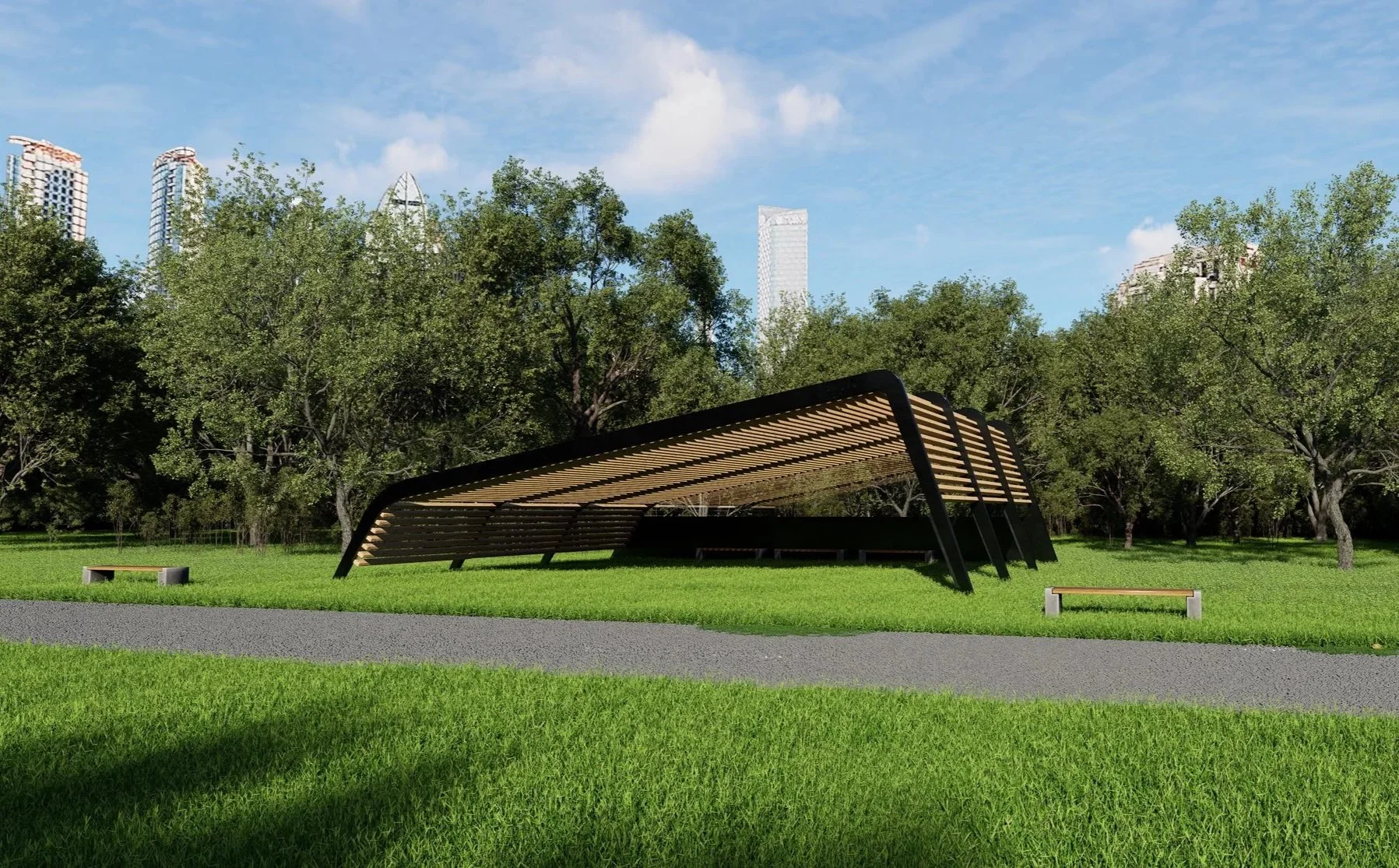
Pause Points proposes a series of pavilions along the trail that give people permission to stop, rest, and connect. The design creates natural gathering moments in a space where everyone is typically moving through alone.
Building the Framework
Before Entering the Field, We Defined What a Healthy Space Means
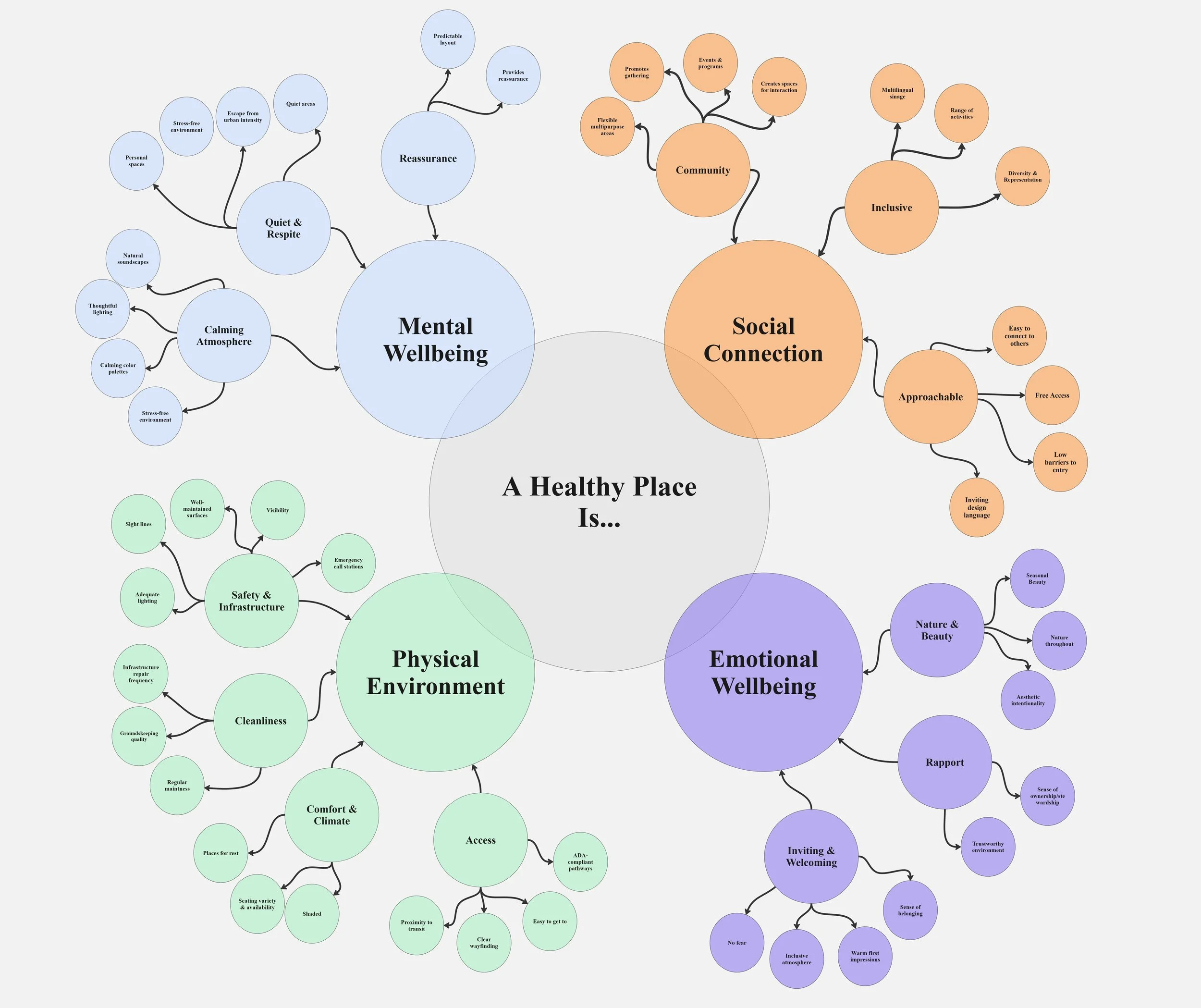
To evaluate parks as healthy spaces, our team first needed a shared understanding of what "healthy" actually looks like in a public environment. Through collaborative brainstorming, affinity mapping, and framework synthesis, we built a comprehensive lens for our field research.
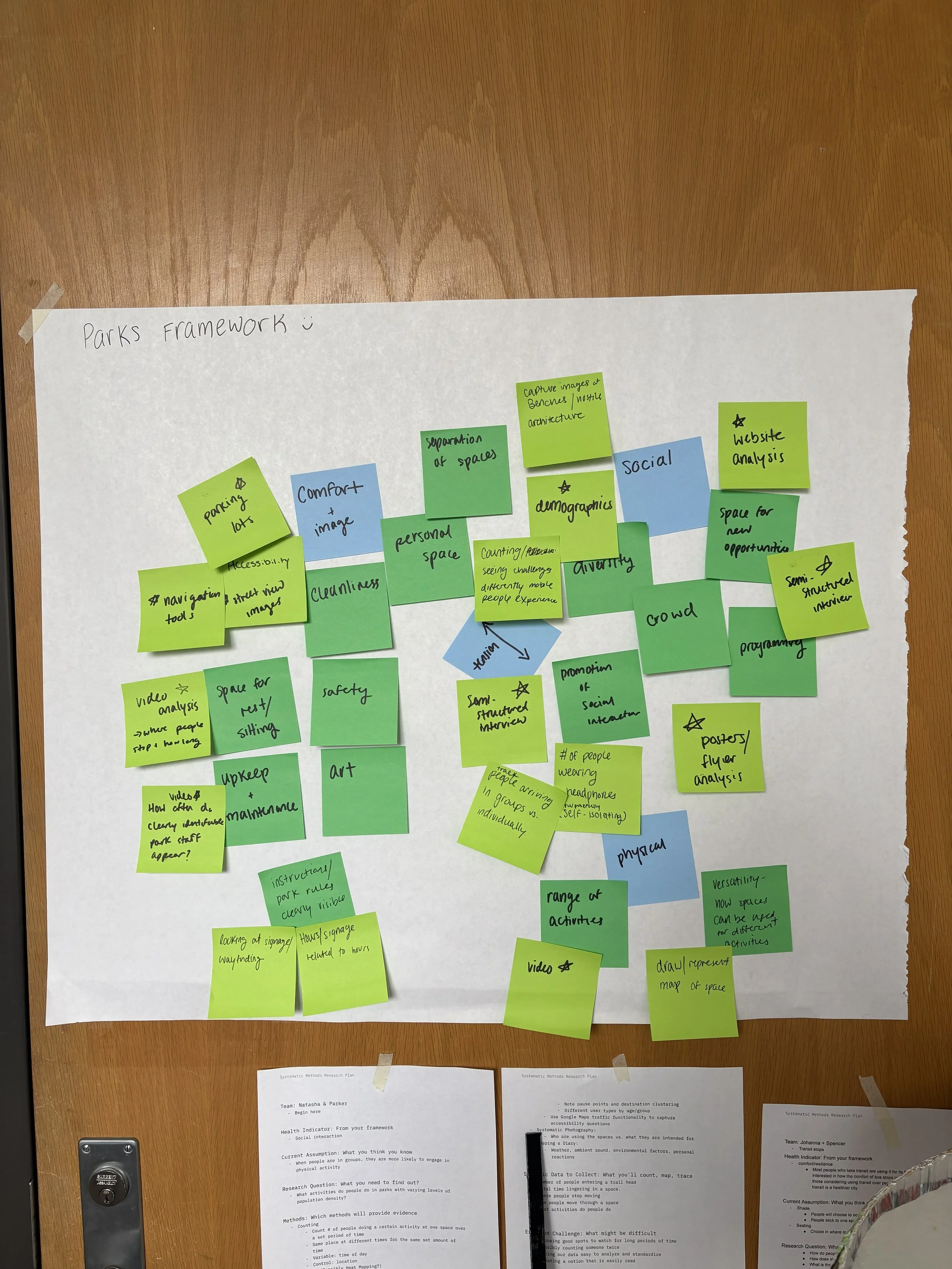
Brainstorming
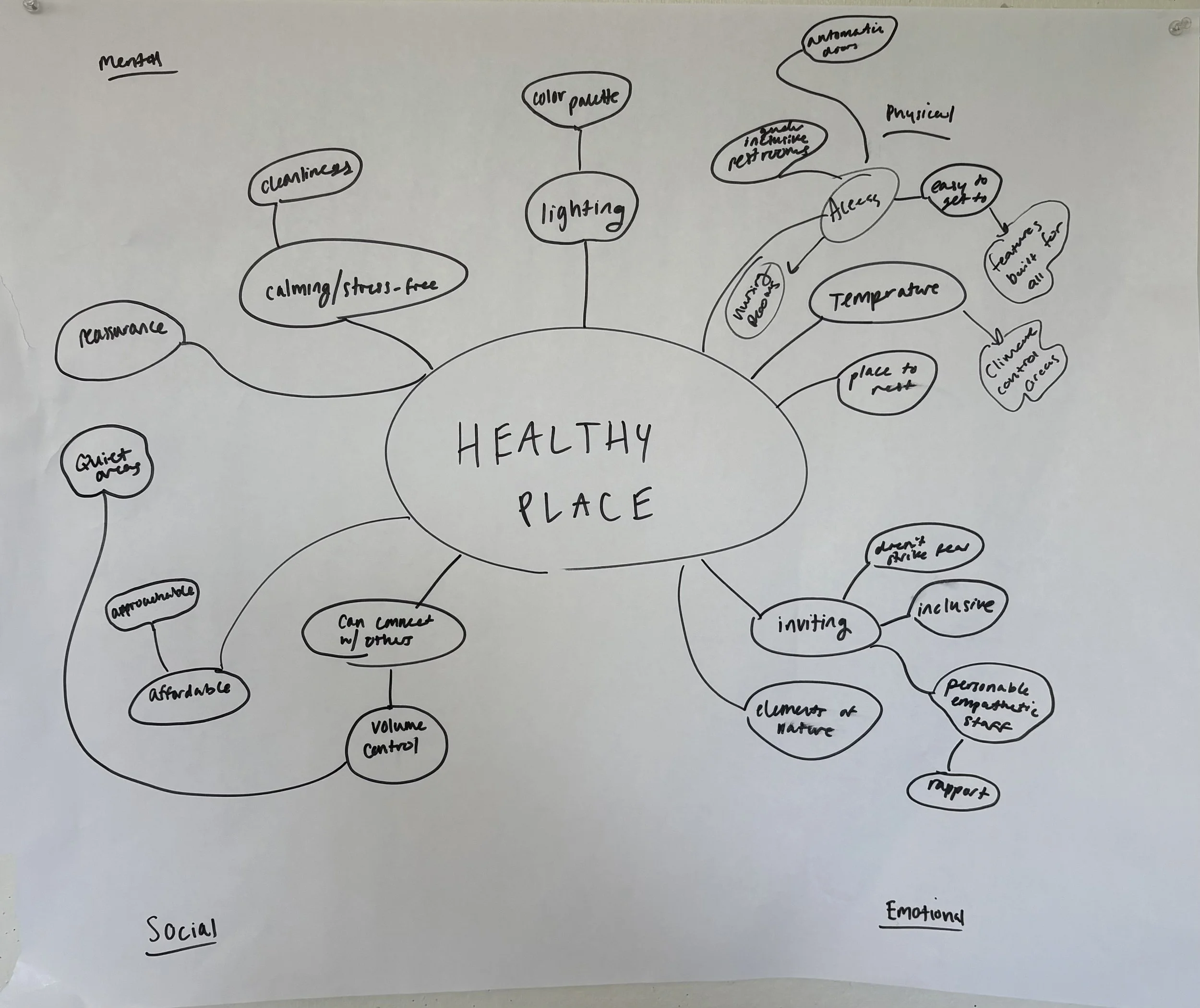
To understand what makes a space support health and well-being, we began with divergent brainstorming, capturing every factor across social dynamics, physical features, operations, and user experience independently before organizing them into patterns. We then synthesized these ideas into a hand-drawn concept map centered on "Healthy Place," revealing four interconnected dimensions: Mental, Physical, Social, and Emotional. This analog mapping process was intentional; it allowed us to quickly iterate on connections and hierarchies without the constraints of digital tools, surfacing branches like "calming/stress-free" under Mental and "lighting and thermal control" under Physical that simultaneously serve multiple dimensions of wellbeing.
The sheer volume and variety revealed that healthy space is far more multidimensional than any single discipline captures, spanning comfort, demographics, crowd dynamics, art, cleanliness, programming, and beyond. The key insight emerged visually: many factors sit at the intersection of multiple dimensions. Lighting, for example, affects physical safety, mental calm, and emotional atmosphere, revealing how evidence-based spatial design must account for the deeply interconnected nature of human experience in place.
Building the Framework
The resulting framework served as a structured evaluation lens for our field research, ensuring we considered health as a multidimensional, interconnected condition rather than a single attribute. Rather than evaluating spaces through just physical safety or social programming, the map forced us to ask layered questions: How does lighting affect visibility, mental calm, and emotional atmosphere simultaneously? This revealed that effective health-supporting environments don't optimize for one dimension at the expense of others; instead, they identify interventions that strengthen multiple aspects of human experience at once.
Building Field Research & Behavioral Observations
Framework in Hand, We Hit the Trail
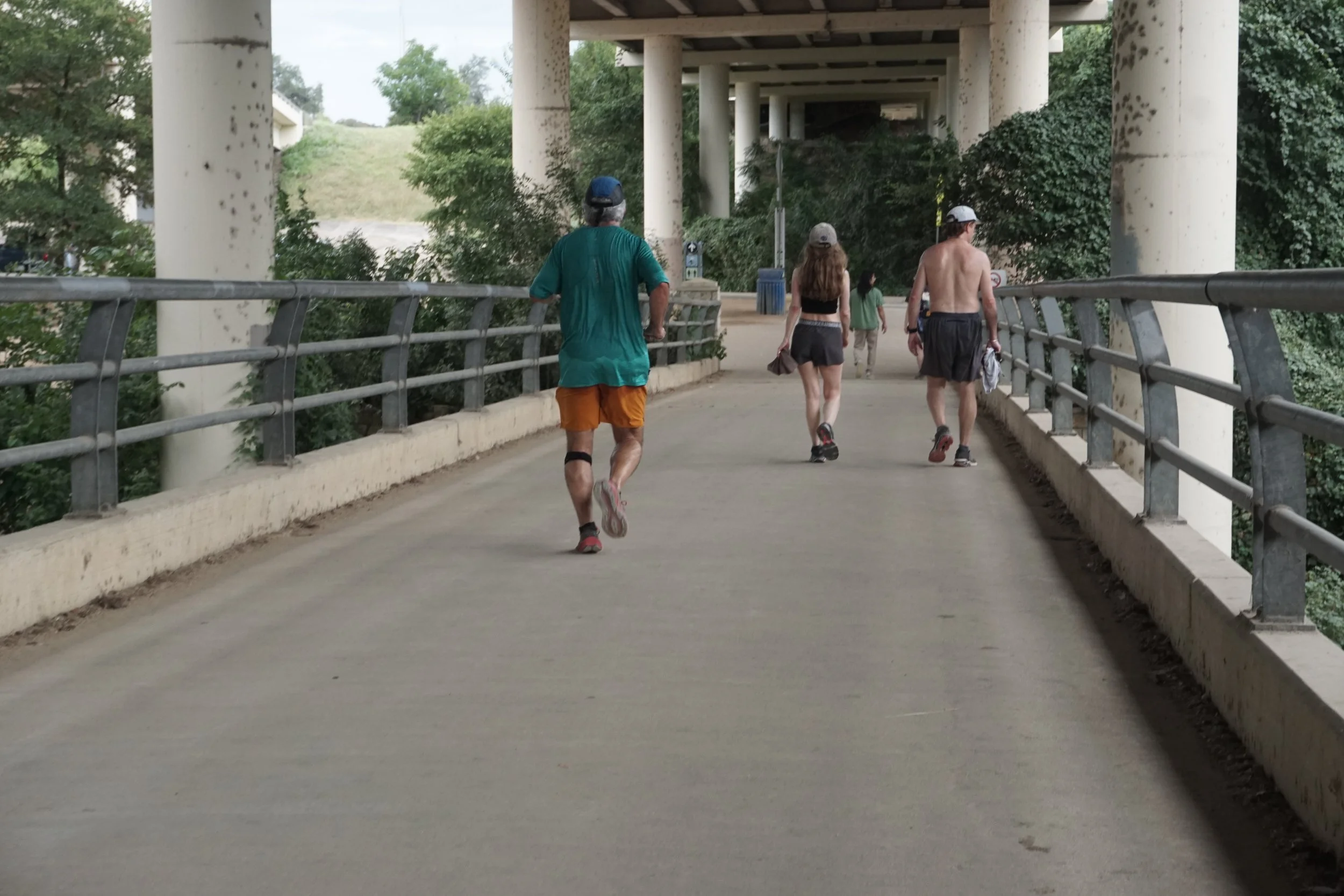
During our fieldwork, we noticed the trail was crowded, but interaction was minimal; everyone focused on their own exercise routines. To test whether we could create connection points, we prototyped simple interventions along the trail.
Movement without Interaction
During our fieldwork, we noticed the trail was full of people, but interaction was minimal; everyone focused on their individual exercise routines. Runners with headphones, cyclists passing through, walkers locked into their own pace.
The space was physically active but socially dormant. Our framework's Social Connection dimension flagged this immediately: despite high foot traffic, there were virtually no connection points designed into the trail experience.
Designing for Connection
The trail already had benches that people ignored. We needed something that felt intentional, a visible destination worth stopping for that could transform a moment of physical relief into an opportunity for social exchange.
The angled canopy acts as a landmark while maximizing shade during peak afternoon heat. Bench seating wraps around the shaded zone, turning a functional need into a social opportunity. We chose wood and steel to feel approachable rather than institutional, with an open structure that invites people in without creating barriers.
Shade as an Informal Pause
Shade was already doing design work, and people were self-organizing around it without any prompting. Despite high foot traffic, we kept observing the same pattern: individuals gravitating toward shaded patches not because the space invited them, but because nothing in the trail's design acknowledged the need to stop.
The opportunity wasn't to invent a new behavior, but to give an existing one a proper home. Pause Points layers thermal comfort, social configuration, and spatial legibility into a single gesture — an angled canopy for shade, bench seating oriented inward, and an open structure distinct enough to signal that stopping here is intentional.
Quantifying Behavior
Turning Observations into Measurable Data
While our team's observations revealed clear patterns in how people used the trail, I wanted to move beyond anecdotal impressions. From my experience working in a neuroethology lab, I knew that quantitative data can surface insights that qualitative observation alone might miss or confirm hunches with hard evidence.
So I built two custom Python programs to extract measurable data from our field video footage, turning hours of trail recordings into structured, exportable datasets.
Spatial Heatmap
The second script generates a spatial heatmap overlay on the video feed, visualizing areas where people most often stop, linger, or slow down. Rather than just counting bodies, this tool reveals where, within the frame, people are drawn to making invisible behavioral patterns visible.
The warm orange-red zones in the output correspond to high-dwell areas, confirming our earlier qualitative observation that shaded spots naturally attract pauses and informal gathering.
Instance Counter
This script detects and tracks individual pedestrians as they move through the frame, counting instances in which they cross a defined boundary line. By assigning directional labels (A→B and B→A), I was able to determine directional foot-traffic patterns, revealing which direction people predominantly travel and how often.
All count data was exported to an Excel spreadsheet for further analysis, giving our team a quantitative foundation to pair with our qualitative observations
Testing Interventions
Prototyping a Moment of Pause
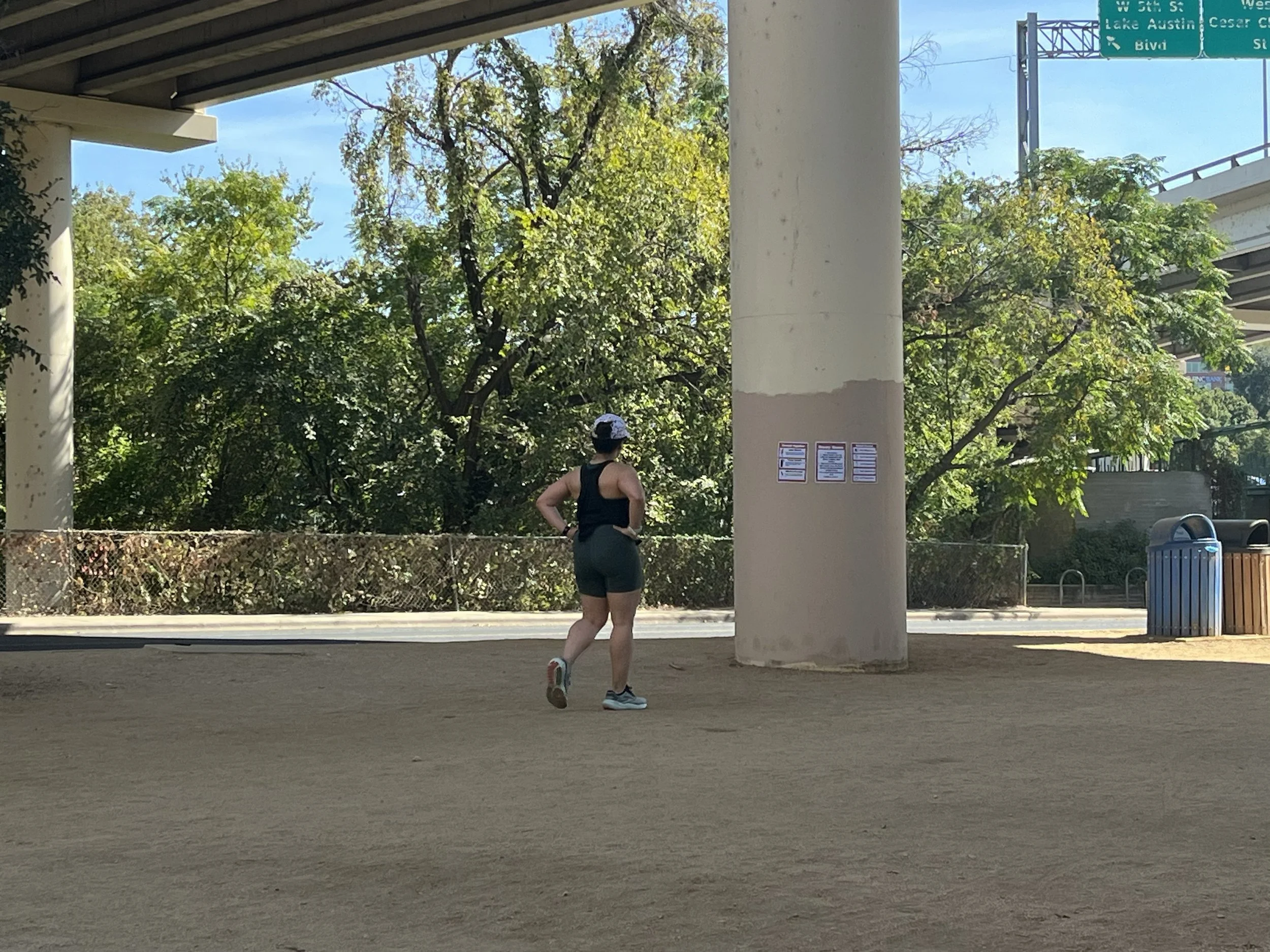
Testing Small Interventions
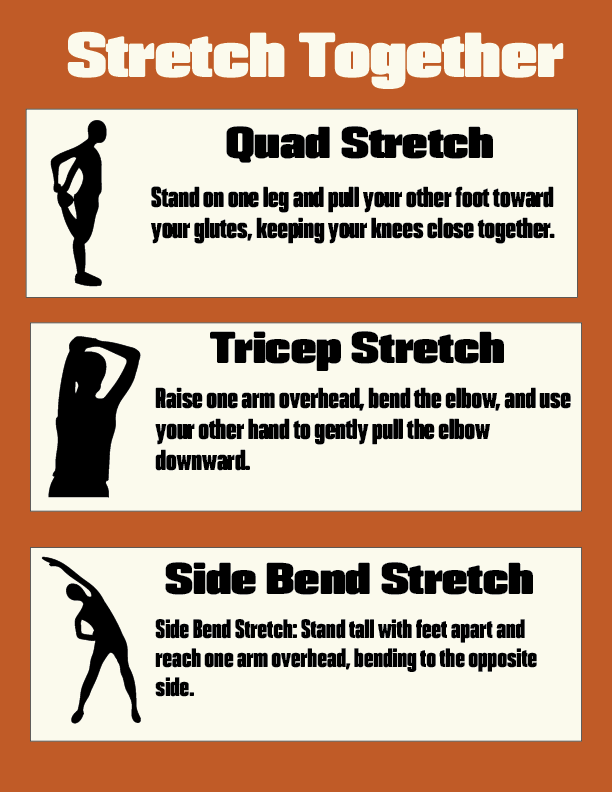
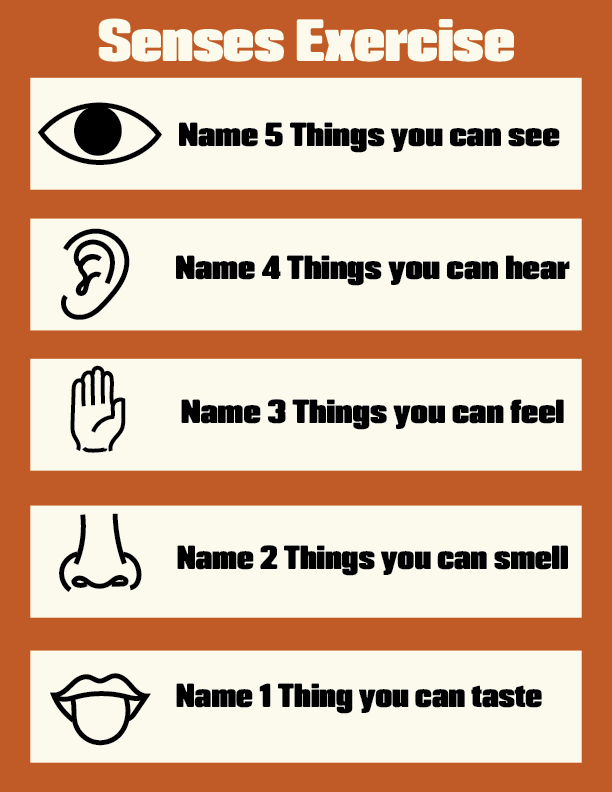
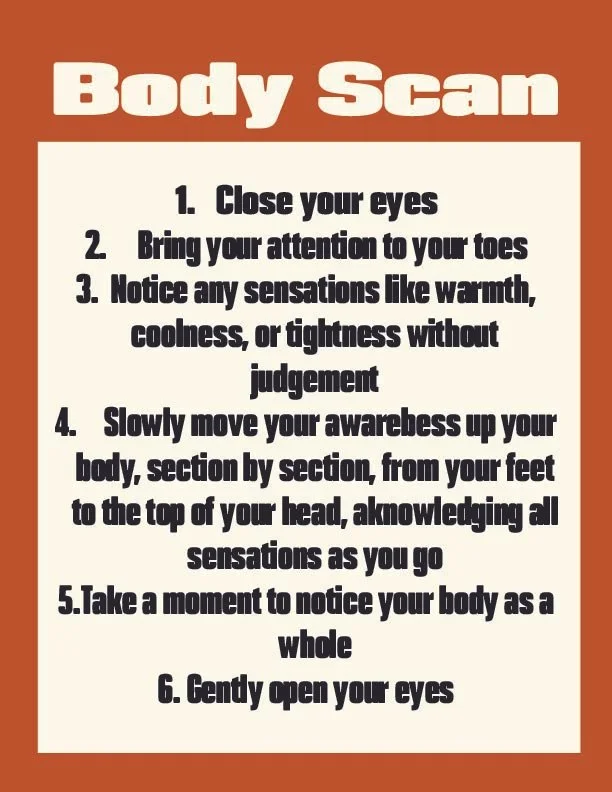
Rather than assume what would make people pause, we tested the threshold between passive infrastructure and active engagement. We wrote exercise and mindfulness prompts on existing infrastructure to see if people would stop and engage. While we saw some informal reactions, it became clear that the intervention needed to be more substantial, something visible and intentional enough to permit people to pause. This rapid prototyping revealed a key insight: creating moments of pause isn't just about programming or signage, it's about spatial legitimacy. People need the environment itself to signal that stopping is welcome.
Spatial Outcomes
Designing Pause Points
Creating a Network of Pause Points
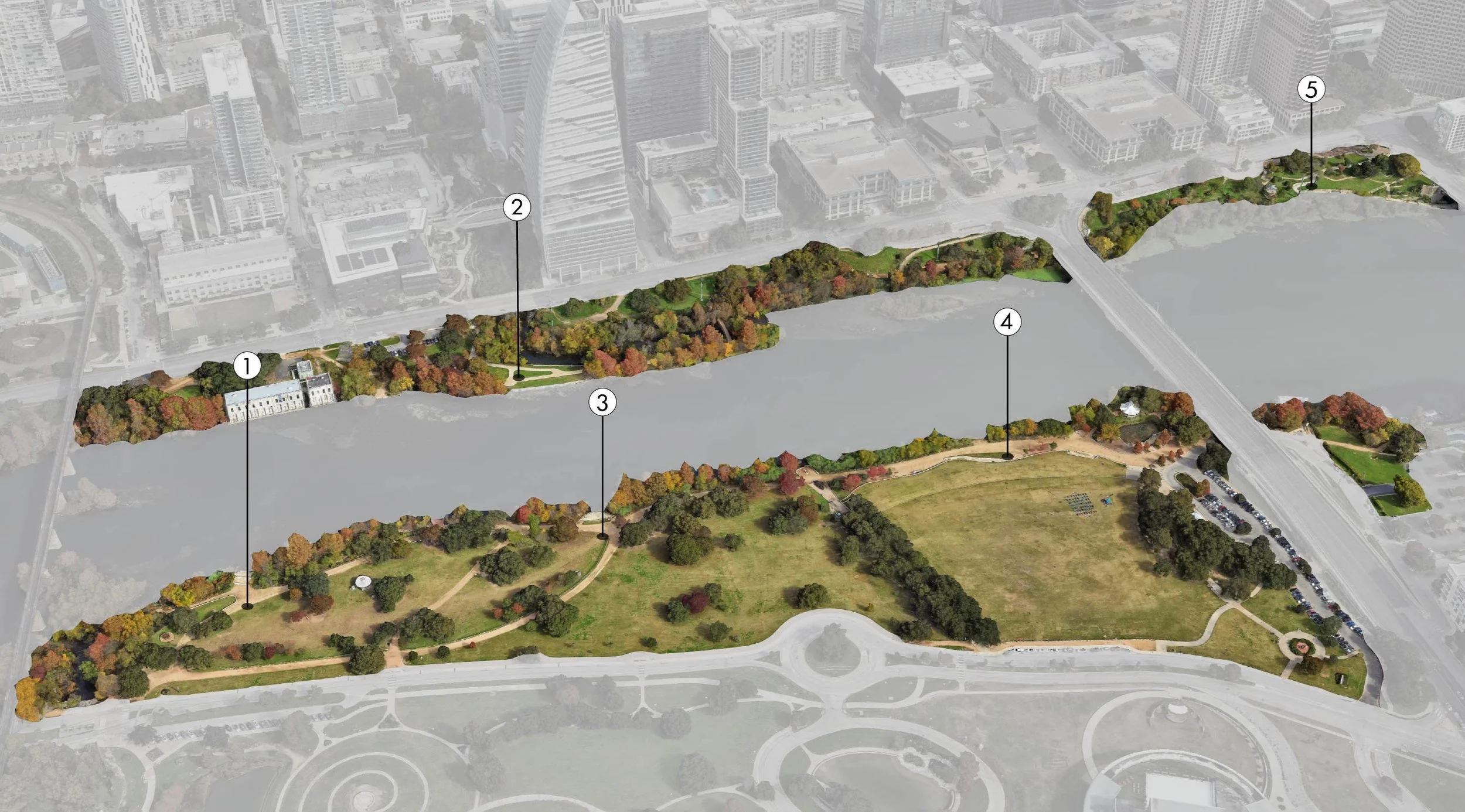
Rather than a single intervention, Pause Points operates as a distributed network along the Lady Bird Lake Trail. We identified five strategic locations where shade is limited and foot traffic is high, places where the need for rest is greatest. By spacing pavilions at regular intervals, we transformed the continuous trail into a series of potential social moments, each point becoming both a functional rest stop and a spatial landmark. This systems-level thinking emerged directly from our framework: effective health-supporting environments don't solve isolated problems; they create interconnected opportunities for physical comfort, social gathering, and mental respite throughout a place's experience.
New Place to Connect
During our fieldwork, we noticed people naturally gathering in shaded spots to escape Austin's heat. This observation revealed a design opportunity: rather than programming where people should pause, we could formalize spaces they're already seeking out. Pause Points translates this into a spatial intervention that layers thermal comfort (angled canopy for shade), social connection (integrated bench seating facing inward), and emotional permission (a distinct structure that signals "stopping here is welcome"). The design demonstrates how fieldwork-driven insights can transform passive observation into purposeful spatial design, addressing multiple dimensions of wellbeing through a single, legible gesture.